
We cannot tackle economic inactivity by expecting people to navigate a fragmented system. We need to take support closer to where people live, build on trusted community relationships and bring the right expertise together.
I have long believed that housing associations and employment support providers have more to achieve together. A visit to the JobsPlus pilot at L&Q Group’s Beaumont Estate in London brought that opportunity into sharp focus.
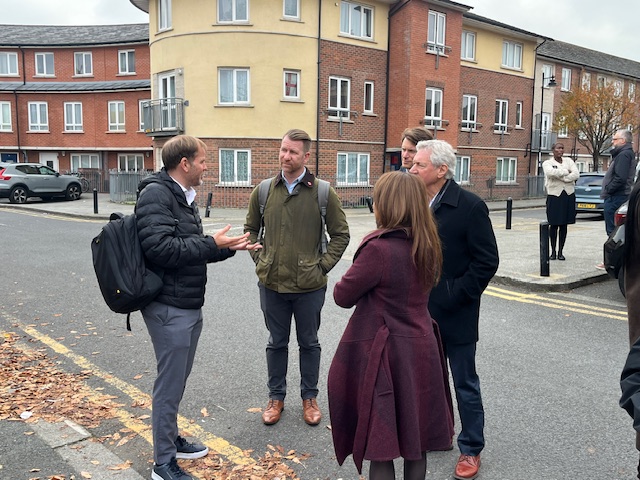
At the invitation of Lynsey Sweeny, CEO of Communities that Work, I joined colleagues from L&Q Group and the Department for Work and Pensions, alongside local residents, to see the programme which is one of the 9 pilots across the country funded by DWP, in action. We heard about its approach, explored the estate and spoke about what more connected support could mean for the people living there.
What struck me was a simple but important point: where employment support happens, and who helps people access it, can be just as important as the support itself.
The case for getting closer to communities
The case for doing more in social housing communities is compelling. Research highlighted by Communities that Work found that social housing residents were nearly twice as likely to be out of work as people in other housing tenures. Those who were working also earned, on average, a third less.
These figures should not be seen as a reflection of people’s ambition or potential. They point to the need for services that better understand people’s circumstances and remove the barriers that can prevent them from accessing opportunities.
Too often, employment support is something people have to seek out, navigate and fit around the rest of their lives. A more effective approach starts by recognising the relationships, organisations and services already present in their communities.
JobsPlus brings together on-site employment support, community connections and financial incentives in a local, accessible model. At the Beaumont Estate, I was particularly interested in how working through L&Q Group’s existing presence could help engage residents who might not otherwise connect with employment services.
That is an important lesson for the wider employment support sector. We need to think beyond where services are commissioned or delivered and focus on how people actually access them.
Partnership, not parallel provision
This is not about employment providers replacing the valuable work housing associations already do. It is about building on existing relationships and bringing additional capacity, specialist expertise and employer connections where they can make a difference.
Community-based programmes such as JobsPlus should not be viewed as a choice between local relationships and specialist employment support. The opportunity is to bring these strengths together, building on existing provision rather than creating competing services. The question is how different approaches can complement one another to help more people access the support they need.
Housing associations understand their communities. Employment providers bring specialist knowledge, employer relationships and experience of helping people overcome barriers to work. Together, these capabilities can create a more connected offer, with less duplication and fewer gaps between services.
We should be designing support around people’s lives, not around organisational boundaries.
Three priorities to take the learning forward
For me, the visit reinforced three practical priorities for future employment support.
- Build partnerships around residents.
Start with what people need and what is already available locally. Bring organisations together early, agree clear responsibilities and create straightforward routes into support. Residents should experience a connected service, not a series of hand-offs between organisations.
- Combine community relationships with specialist expertise.
Housing associations have trusted local relationships and a deep understanding of their communities. Employment providers bring specialist support and connections to employers. We should be looking at how these strengths complement one another, rather than commissioning services in isolation.
- Be ambitious, but evidence-led.
There is real value in exploring approaches that bring services closer to communities, but we must be honest about what works. We need to understand not just whether people engage with support, but whether it helps them move into employment, sustain work and improve their longer-term prospects. Learning should inform future commissioning and service design.
These principles are relevant well beyond one programme or one estate. But applying them successfully means understanding local circumstances rather than just replicating a model elsewhere. Good partnerships take time, clear purpose and a willingness to learn together.
Making the connections count
Thank you to L&Q Group, Communities that Work and the residents of the Beaumont Estate for sharing their experience and welcoming us.
I came away with a reinforced conviction: housing and employment support have much more to offer one another. At a time when tackling economic inactivity and improving employment outcomes are national priorities, we cannot afford to overlook the organisations already connected to the communities we want to reach.
If we want employment support to reach more people, we need to start by getting closer to them. There is real opportunity to turn shared potential into practical action: stronger partnerships, better-connected services and more accessible routes into work.
I’m looking forward to seeing how the remainder of the Jobs Plus pilots go, and the impact that they have as part of the DWP evaluations.
