
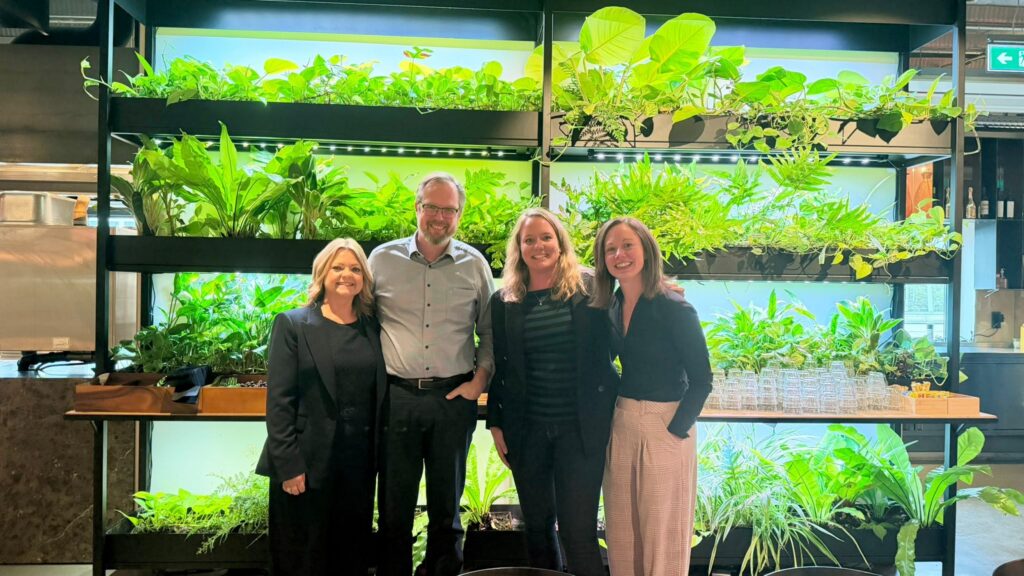
What can the UK learn from the Netherlands about designing better public services, supporting people into employment and creating more effective partnerships? Good policy starts with understanding what works and what we can learn from others. Debbie Braid, AKG’s Chief Operating Officer, and Natasha Harvey, AKG’s Business Development Director, travelled to Utrecht in the Netherlands to explore Dutch policy and practice and identify lessons for the UK.
They met leaders in impact reporting, youth employment and youth justice, asking what works, why it works, and what could be adapted. The aim was not to copy the approach but to find ideas that could inform AKG’s services and wider policy discussions.
Natasha has written a blog on their travels…
Lessons from Utrecht: what the UK could learn from the Dutch system
I went to Utrecht expecting canals, bikes and the opportunity to eat lots of stroopwaffles. I came home thinking more about public policy, employment support and what the UK could learn from the Dutch approach. During our visit, hosted by Whitney van Schyndel, founder of Amplify Impact, we explored how the Netherlands approaches some of the challenges facing public services and communities.
Whitney previously spent five years working at the Challenge Fund for Youth Employment and brought a wealth of experience and insight into our discussions.
Her motto is “Sometimes the truth has teeth” (possibly now my favourite sentence of 2026!)
During our discussions, Whitney asked us to consider why the Dutch are generally comfortable with leaving their curtains open for everyone to see in. Her observation was that there is a cultural attitude of openness, with nothing to hide what goes on behind closed doors.
It prompted an interesting comparison with the UK, where we have perfected the net curtain, allowing us to look out while ensuring no one can see in. There is perhaps a wider lesson here for UK commissioning. How open and transparent are we prepared to be about how services are designed, decisions are made and outcomes achieved?
Every session Whitney led us through during our visit ended on three questions. What good ideas could we copy? What would need adapting? And what only works because it’s in the Netherlands?
Across our discussion, four areas stood out as particularly relevant to the UK and an important consideration throughout was that these approaches cannot be lifted from one country and transferred into another. They are rooted in different political, economic, and cultural systems. The challenge is to understand what makes them work and what we might adapt to improve outcomes here.
1. Get everyone in the room before deciding anything
‘Poldering’ is at the heart of how decisions are made in the Netherlands. This idea is believed to have originated in the Middle Ages when communities had to cooperate to maintain the polders- cooperation and shared responsibility for the dykes, or the polders would have been flooded, and everyone would have suffered. So for centuries, people who might otherwise disagree had to sit down and agree to cooperate.
That principle evolved into the polder model: reaching consensus through social dialogue, with each party having an equal voice. It flows across various aspects of society: whether at the kitchen table or the highest levels of government, decisions are made by consensus.
The Netherlands’ main “table”, the Social and Economic Council, has 11 employers, 11 union representatives and 11 independent experts. Agreements can take time, but they stick. The 1982 Wassenaar Agreement and the 2019 pension deal both outlived the governments that negotiated them.
The UK is what the political scientist Arend Lijphart used as the textbook opposite. Win the election, write the policy, then consult. AKG is passionate about policy being shaped and services being designed with employers, workers, providers and people with lived experience all in the room.
2. Don’t lose track of young people at 18
The Netherlands has the lowest rate of young people not in education or training ( NEET) rate in the EU.
In 2025, 5.3% of Dutch 15 to 29-year-olds were NEET (Eurostat). In the UK it’s 13.0% of 16 to 24-year-olds, or 981,000 young people (ONS, April to June 2026). Whilst this data doesn’t offer a like-for-like comparison, the contrast is still stark.
The Dutch rate reflects both its support systems and culture. Learning is compulsory until 18 or a basic qualification. If young people don’t attend school or college, the council’s attendance officer follows up. From 18 to 27, a regional team called the Doorstroompunt does. Vocational colleges are wired into local job markets. And some of it is culture: it is common for Dutch teenagers to work part-time alongside school (RAND for Youth Futures Foundation).
It’s not perfect: 28,809 Dutch young people left without a qualification in 2024-25. But one of Whitney’s slides captured the key difference “Every drop-out point has an owner”. In the UK, it just doesn’t feel as though the same clear ownership exists.
3. Make the employer own the sick note
In the Netherlands, employers must pay at least 70% of an employee’s wages for up to two years. That gives employers a strong incentive to help people return to work.
By week six a company doctor assesses the employee and by week eight there’s a return-to-work plan. If returning to the same job is no longer realistic after a year, a “second track” helps the employee find work elsewhere. Dutch employers have every incentive to support their staff back into work; paying someone’s wages for 104 weeks isn’t cheap.
In the UK, statutory sick pay lasts up to 28 weeks. Then it’s Universal Credit, by which point the job, routine and often the person’s confidence have quietly left the building. Whilst we clearly can’t simply implement the Dutch model here, there are elements of good practice we could explore which align with the UK’s Keep Britain Working review.
4. Devolve and coordinate funding
Since 2015, 342 municipalities have run social assistance, youth care and social support, funded mostly through primarily a general grant they spend as they see fit. The 342 municipalities sit within 35 labour market regions, planning and coordinating provision with UWV (the Dutch employee insurance agency), employers and colleges. They then buy specialised, local support. In addition, each labour market region is set to get a “Werkcentrum” as a single front door for residents. The intention is to bring together organisations that might otherwise operate separately, creating more coordinated support for residents and stronger links with local employers.
This looks similar to the direction in which the UK is headed, with devolution gathering momentum across the country. For further thoughts from AKG on how localised decision-making can improve public services, please feel free to check out our report.
Dank je wel
Thank you to Whitney for being such a brilliant host, and to our other partners for sharing their insights. There are further learning briefs on the Challenge Fund for Youth Employment here.
The timing of these discussions in the Netherlands is particularly relevant. Here in the UK, we are approaching an important moment in the future direction of employment and welfare support. The growing focus on devolving employment support and giving areas greater control over how services are designed and delivered creates a real opportunity to put some of these principles into practice.
Our challenge to commissioners, Mayoral Strategic Authorities, local authorities, employers and delivery partners is this: don’t wait for the next policy announcement. Start working differently, bring people together, look honestly at where the current system is falling short, and identify what could be done differently. At AKG, we welcome the opportunity to work with you on that conversation, sharing, learning, challenging established thinking and exploring how connected, local, responsive employment support can deliver better outcomes for individuals, employers and communities. The Netherlands has given lots of us to think about, and now it’s time to turn that thinking into action.
